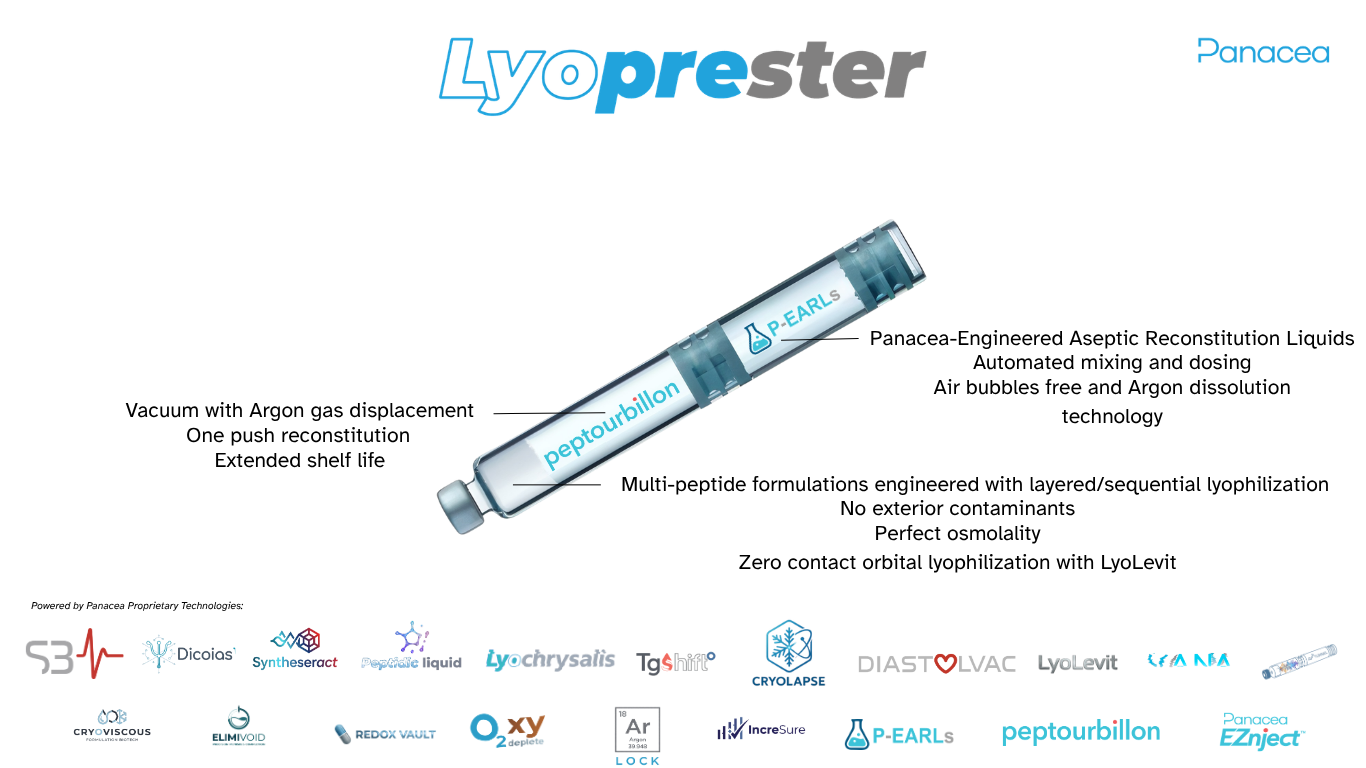
The dose that carries its own solvent — ready in one quick action.
Freeze-drying keeps a fragile peptide alive on the shelf — but a dry cake is not a dose. Before it can be given, someone must dissolve it back into liquid: a second vial, a needle, a steady hand. GoQuick Dual removes that person from the equation. Cake and solvent ride in two chambers of one pre-filled cartridge; a single action breaches the septum between them and reconstitutes the dose where it is needed — no diluent vial, no manual mixing, no needle reconstitution dance.

The last step lyophilization never solved
A freeze-dried injectable is born as two products: the drug vial and the diluent vial. Reuniting them has always been someone's hands, someone's needle, someone's margin for error.
Vial + separate diluent — the manual dance
- Draw the solvent, inject it into the drug vial, swirl until dissolved, withdraw the dose — every transfer a chance for a wrong volume or a touched needle.
- Open needle transfers are a real contamination surface; preparation time and wastage carry real cost. A 2026 hospital-pharmacy analysis of lyophilized thiotepa cites a study in which 15% of doses were prepared out of tolerance.
- Industry's answer is shifting to ready-to-dilute and ready-to-use formats — evidence that the manual reconstitution step itself is the liability.
GoQuick Dual — the dose reconstitutes itself
- The solvent is already on board, pre-metered in the cartridge. No second vial exists to be fetched, drawn or misread.
- One action joins the chambers; the mixing path never opens to air. No external bacteriostatic water, no transfer, no manual measuring.
- The active stays dry — its most stable state — until the instant of use: dosing at the bedside, in the field, or by the patient at home.
What GoQuick Dual is
GoQuick Dual is Panacea Bio Chem's intelligent reconstitution technology in a dual-chamber cartridge: a pre-filled, two-chamber device in which the freeze-dried (lyophilized) cake and its solvent stay apart through manufacture, shipping and storage — so the active ships dry, its most stable state — and meet only at the moment of use.
Two chambers, one action
One chamber holds the lyophilized cake, the other a precisely measured reconstitution liquid, separated by an internal septum. One push breaches the septum, the solvent floods the cake, and after a gentle agitation the dose is dissolved and ready for syringe extraction — inside a closed, sterile path.
The name is the promise
Go, quickly, dual: two chambers — cake and solvent held apart until use — and one quick action that joins them. The name carries the whole mechanism.
Built for pharma
Panacea presents GoQuick Dual as a platform for pharmaceutical companies working with peptides, biologics and specialty injectables: accurate microgram-to-milligram dosing, integration with custom reconstitution liquids, and formats for both clinical and consumer use.
Made by VANA
Panacea states that GoQuick Dual is made possible by its proprietary VANA machine — a high-precision pharmaceutical assembly system enabling multi-layer lyophilization, vacuum-sealed chambers and airless micro-volume transfer.

The Panacea stack behind one push
A self-reconstituting cartridge is only as good as the cake inside it, so Panacea designs the cartridge and the freeze-dry together. GoQuick Dual carries Panacea's P-EARL formulation and is produced with the Cryolapse low-temperature lyophilization method, DiastolVAC vacuum control and the S3Pulse biointegrity algorithm, assembled on the VANA machine. For end users, Panacea pairs the cartridge with its EZnject kit — the pre-filled dual-chamber cartridge, alcohol wipes, a disposable auto-injector pen, a needle matched to therapy type and viscosity, and cold-chain packaging for clinical or at-home use.
The exact internal geometry, chamber sequencing and materials remain Panacea intellectual property: the outline is here; the mechanism stays behind the door.
Device description · Panacea-stated capabilities labelled as such
"Everyone accepted the second vial as the price of a stable drug. We asked why the dose should not simply carry its own solvent. Once cake and solvent travel together — apart until the moment of use, one push apart from mixed — the whole reconstitution choreography collapses into a single action. That is when a fragile peptide stops needing a pharmacy to be given."
About the researcher: Bogdan Dicoias — Biochemist · AAC Designer · Director of Panacea Bio Chem Ltd
What we state, and how we state it
This page describes a proprietary device, so it draws a clear line. The dual-chamber principle, the reconstitution problem and the industry trend toward ready-to-use formats are documented in open sources — the references below. The GoQuick Dual-specific capabilities (dosing range, VANA assembly, EZnject pairing) are Panacea Bio Chem's own statements from its published materials, labelled as such. We publish no specifications, doses or performance numbers beyond what those sources state.
Shown
The problem, the mechanism at the level of principle (two chambers, septum, one action), the established dual-chamber precedent, and the open literature on what manual reconstitution costs.
Held back
Chamber geometry, septum design, sequencing, materials and cycle parameters — the best dual-chamber engineering on the market, because it is what Panacea says it is. Proprietary Panacea design, held back by choice.
Frequently asked questions
What is the GoQuick Dual cartridge?
GoQuick Dual is Panacea Bio Chem's dual-chamber, pre-filled, self-reconstituting cartridge. The freeze-dried (lyophilized) cake sits in one chamber and its solvent in the other, held apart by an internal septum, so a single action reconstitutes the dose at the point of use — no separate diluent vial and no manual mixing.
How does the one-action reconstitution work?
One push of the plunger breaches the septum between the chambers and releases a precisely measured reconstitution liquid into the cake chamber. After a gentle agitation the lyophilized compound is fully dissolved and ready for syringe extraction, all inside a closed, sterile path.
Why does carrying its own solvent matter?
Conventional lyophilized drugs ship as a dry vial plus a separate diluent vial that someone must draw up and transfer by hand — every transfer a chance for a dose-volume error or contamination. When the dose carries its own solvent, that manual step disappears, which suits point-of-care dosing, field and emergency medicine, and self-administration.
Who developed GoQuick Dual?
GoQuick Dual was developed by Bogdan Dicoias and is the intellectual property of Panacea Bio Chem Ltd. Panacea states that it is produced on the VANA assembly machine together with the Cryolapse lyophilization method, DiastolVAC vacuum control and the S3Pulse algorithm; the internal geometry remains proprietary. More answers on the Questions page.
Trending in the field
Recent developments in the field — refreshed 2026-09-07 by Panacea Bio Chem.
- A modeling framework for spring-driven autoinjectors with dual-chamber cartridges — PubMed, 2026 Feb
- Recommended Best Practices for Lyophilization Validation 2021 Part II: Process Qualification and Continued Process Verification — PubMed, 2021 Nov 8
- Dual chamber cartridges in a continuous pharmaceutical freeze-drying concept: Determination of the optimal dynamic infrared heater temperature during primary drying — PubMed, 2019 Oct 30
- Efficacy and safety of an albiglutide liquid formulation compared with the lyophilized formulation: A 26-week randomized, double-blind, repeat-dose study in patients with type 2 diabetes mellitus — PubMed, 2019 Jun